Skip to content
Hearth & Patina

Care & Seasoning

How to Sear Without Setting Off the Smoke Alarm

Almost all searing smoke comes from one of three things, and two of them are free to fix. The oil you chose, the water you left on the meat, and how hard you had to drive a pan that was too small.

By Stephen V.Updated How we research
#ad

We earn a commission when you buy through our Amazon links, at no extra cost to you. It never affects our rankings, and we say so when the cheaper pan is the better buy. How this works.

If one change: stop searing in extra virgin olive oil or butter. Wikipedia's table puts extra virgin olive oil's smoke point at 374°F and butter's at 302°F , while a hard sear runs the pan surface well above both — so the smoke you are seeing is the fat failing, not the steak cooking. Swap to refined avocado oil (520°F), clarified butter or ghee (482°F), beef tallow (480°F) or refined peanut or sunflower oil (450°F), dry the meat properly, and give yourself a pan big enough that you do not have to drive the burner to maximum. Those three changes remove most indoor searing smoke without costing you any crust.

This is a different question from “why does my cast iron smoke when it is empty”. If your pan smokes on a dry preheat with no food in it, the problem is the seasoning or residue on the pan and the page you want is why does my cast iron smoke. This page is about the smoke that happens while you are cooking— the kind that ends a steak night with a chair, a tea towel and a beeping ceiling.

Where the smoke is actually coming from

1. The fat has gone past its limit

Every fat has a temperature at which it begins to break down visibly. Past it you get acrolein and other volatile breakdown products — that acrid catch at the back of the throat which is quite distinct from the smell of browning meat. Smoke point is not a fixed property of a plant, either: it depends on refinement. Wikipedia notes that free fatty acids and proteins lower the smoke point, which is exactly why refined oils and clarified butter sit so much higher than their unrefined versions. It also notes that reused oil smokes at a lower temperature — so yesterday's frying oil is a worse choice than it was yesterday.

2. There is water on the food

A wet surface cannot brown until the water has boiled off, so you compensate by turning the heat up and holding it there for longer. Both of those make smoke. Patting a steak thoroughly dry — and better, salting it hours ahead and leaving it uncovered in the fridge — lets you sear at a lower setting for less time, which is the single most effective free fix on this page.

3. The pan is too small, so you are overdriving it

This one is counterintuitive and it is the real reason many kitchens smoke. Two steaks in a 10-inch pan sit close together, release moisture into a crowded space, and crash the surface temperature — so you push the burner harder and keep it there. A 12-inch pan with more stored heat and more room between items does the same job at a lower setting, in less time. Buying a bigger pan to make less smoke sounds like a sales pitch; it is simply what the physics says.

4. Loose residue and old oil on the pan

Carbonised flecks from the last cook and a film of oil left on a stored pan both burn off again on the next preheat. Sticky, under-polymerized seasoning does the same thing every single time you use the pan. If smoke starts beforethe food goes in, fix that first — see why is my cast iron sticky.

5. Extraction that is not really extracting

Many range hoods recirculate through a filter rather than venting outdoors, which does very little for the volume of smoke a sear produces. A ducted hood run on high from before the pan goes on is worth more than any technique change, because it is moving the smoke out instead of asking you not to make any.

What to look for in a pan and a fat, if you are buying

Surface area over everything. The spec that reduces smoke is room: a 12-inch skillet rather than a 10, so items are not crowded and you can run a lower setting.

A lid, or deep sides, if splatter is part of the problem. A deep covered skillet contains spitting fat and lets you drop a lid on for a moment without steaming the crust the way a full braise would. It is also the pan that makes shallow frying indoors tolerable.

A press, for anything thin. Full contact means a shorter time at high heat, and time at high heat is what generates the smoke. For burgers and bacon this is the single biggest reduction available.

A refined fat with headroom.You do not need the 520°F oil; you need one comfortably above where you are cooking. Tallow and ghee are both excellent and both taste of something, which matters more than the last fifty degrees.

The three pieces we would reach for are ranked below.

The routine that works

Extractor on high before the pan goes on. Window open if you have one. Pan preheated on medium-high — not maximum — for long enough that it is evenly hot; preheating properlymeans you can use a lower setting than you think. Food bone dry. A thin film of refined fat, added to the hot pan rather than heated up with it, so it spends the minimum time at temperature. Food in, then leave it alone — moving it around does nothing except extend the cook.

Butter, garlic and herbs go in at the end, after you have dropped the heat. That is not just a flavor decision; it is the whole reason restaurant kitchens baste late. At 302°F, butter in a searing pan is smoke with a nice smell.

And if the alarm is in the kitchen doorway, consider whether it is the right alarm in the right place. A photoelectric alarm directly outside a kitchen will cry wolf at cooking smoke for the rest of its life. Relocating it is a legitimate fix — relocating, not removing or disabling it.

What you should not do

Do not sear colder to avoid smoke. You will lose the browning entirely and end up with gray, steamed meat. Change the fat and the pan size instead; the goal is the same crust with less fat breakdown, not a worse sear.

Do not take the battery out of the smoke alarm. Obvious, widely done, and the reason a surprising number of kitchen fires get discovered late.

Do not switch to nonstick for this. High-heat searing is the one job nonstick coatings are least suited to; the comparison is in cast iron vs nonstick.

Do not assume it is your seasoning. If the pan is quiet on a dry preheat and only smokes once the oil and food are in, your seasoning is fine and the fat is the variable.
The short answer

Quick picks

#ProductBest forScorePrice
01
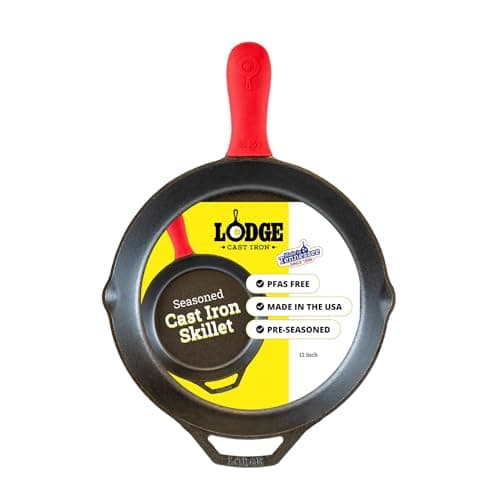
Lodge Lodge Seasoned Cast Iron Skillet, 12"
Lodge Seasoned Cast Iron Skillet, 12"

The big-batch workhorse. More searing room, more weight, same near-unkillable Lodge value.

Cooking for a family
8.4
$28.99Amazon
02
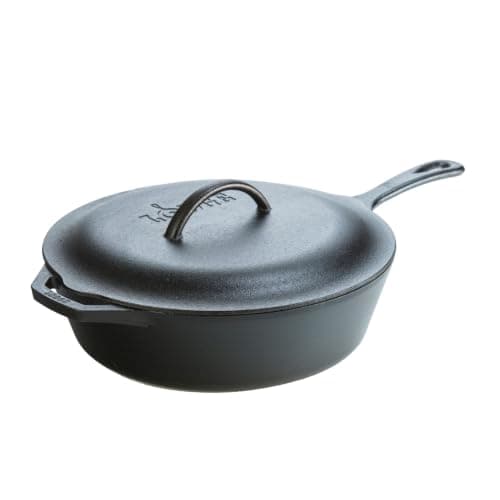
Lodge Lodge 5 qt Cast Iron Covered Deep Skillet
Lodge 5 qt Cast Iron Covered Deep Skillet

The dedicated frying pan: tall sides hold a safe depth of oil, a lid tames splatter, and cast iron holds the oil temperature steady when the food goes in.

Deep and shallow frying
8.0
$69.90Amazon
03
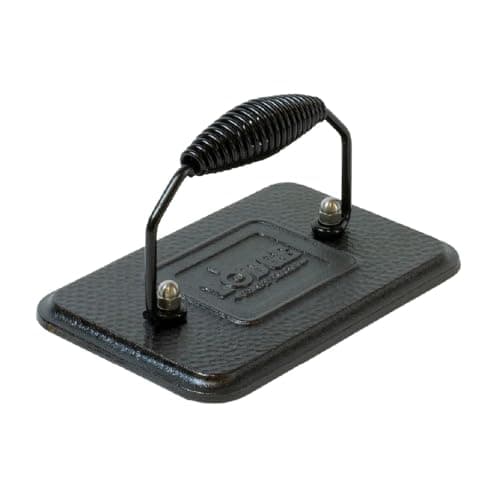
Lodge Lodge Cast Iron Grill Press
Lodge Cast Iron Grill Press

The cheap heavy weight that turns bacon flat and smash burgers crisp — a small tool that noticeably improves a grill or griddle.

Bacon, smash burgers & paninis
8.3
$27.21Amazon

#ad · Live prices from the Amazon Product API, as of October 5, 2026. Where we have no verified live price, we show none — we would rather leave a gap than print a number that has gone stale.

In detail

The picks, in full

01
Lodge Lodge Seasoned Cast Iron Skillet, 12"

Cooking for a family

Lodge Seasoned Cast Iron Skillet, 12"

12 inPre-seasonedMade in USA~8 lb
8.4/10

The big-batch workhorse. More searing room, more weight, same near-unkillable Lodge value.

Heat retention
10
Cooking surface
7
Handling
6
Versatility
9
Value
10

Pros

  • The extra diameter is the difference between searing two chicken thighs and searing six without crowding
  • Deep enough sidewalls for shallow-frying and pan sauces
  • Includes a silicone handle holder in the box

Cons

  • At roughly 8 lb full, it is genuinely heavy — one-handed tossing is out for most people
  • Overkill for one or two servings; a bare 8" or 10.25" is the everyday pan

Don't buy this if…

…you mostly cook for one or two. A 12" pan that lives in the cupboard because it is too heavy to bother with is worse than a 10.25" you reach for daily.

$28.99View on Amazon

$34.9017% off

Price as of October 5, 2026. Prices change — Amazon's is the one that counts.

#ad · we may earn a commission from this link to Lodge Seasoned Cast Iron Skillet, 12"

02
Lodge Lodge 5 qt Cast Iron Covered Deep Skillet

Deep and shallow frying

Lodge 5 qt Cast Iron Covered Deep Skillet

5 qtDeep sides + lidPre-seasonedMade in USA
8.0/10

The dedicated frying pan: tall sides hold a safe depth of oil, a lid tames splatter, and cast iron holds the oil temperature steady when the food goes in.

Heat retention
9
Frying depth
9
Versatility
8
Handling
6
Value
8

Pros

  • Tall, straight sides hold enough oil to fry safely without the shallow splatter of a regular skillet, and the lid contains spatter and stores the pan
  • Cast iron's thermal mass keeps the oil temperature from crashing when cold food hits it, which is the whole secret to crisp, non-greasy frying
  • A true family-size 5-quart pan that also braises, sautes, and simmers, made in the USA and pre-seasoned

Cons

  • Heavy, especially once loaded with oil — moving hot oil is a two-hand, full-attention job
  • Bare iron, so long deep-frying is fine but acidic simmers are better left to enamel, and it needs drying and re-oiling after a wash
  • More pan than someone who only ever shallow-fries needs

Don't buy this if…

…you only shallow-fry the occasional egg or chop — a plain 10.25" or 12" skillet is enough. Buy the deep skillet if you fry chicken, doughnuts, or fries often and want the depth and the lid.

$69.90View on Amazon

Price as of October 5, 2026. Prices change — Amazon's is the one that counts.

#ad · we may earn a commission from this link to Lodge 5 qt Cast Iron Covered Deep Skillet

03
Lodge Lodge Cast Iron Grill Press

Bacon, smash burgers & paninis

Lodge Cast Iron Grill Press

6.75 x 4.5 inCool-grip handlePre-seasonedMade in USA
8.3/10

The cheap heavy weight that turns bacon flat and smash burgers crisp — a small tool that noticeably improves a grill or griddle.

Heat retention
8
Build quality
9
Versatility
7
Value
9

Pros

  • Heavy cast iron presses bacon, burgers, paninis and chicken flat for full contact and even, crisp browning
  • Preheat it and it adds its own stored heat to the top of the food, searing both sides at once
  • A wood cool-grip handle keeps your hand off the hot metal; cheap, made in the USA, and near-indestructible

Cons

  • A single-purpose accessory — useful, but it does not cook on its own
  • Bare iron that needs the same seasoning and drying care as a skillet
  • The rectangular face is sized for a few strips or one smash burger at a time

Don't buy this if…

…you do not smash burgers, press paninis, or want flat bacon. It is a genuinely handy add-on for a griddle or grill, but it is an extra, not an essential first purchase.

$27.21View on Amazon

Price as of October 5, 2026. Prices change — Amazon's is the one that counts.

#ad · we may earn a commission from this link to Lodge Cast Iron Grill Press

How we picked

We do not run a testing lab

We researched published manufacturer specifications, materials and thermal properties, and aggregated owner reviews, then scored each pan against a published rubric. The scores are judgments from documented research — they are notmeasurements we took, because we do not have a lab and we are not going to pretend we do. Where a number came from a manufacturer's spec sheet or someone else's lab, we name it in Sources.

Questions

Frequently asked

What oil should I use to sear steak without smoke?
A refined, high-smoke-point fat: refined avocado (520°F), clarified butter or ghee (482°F), beef tallow (480°F), refined peanut or sunflower (450°F). Avoid extra virgin olive oil (374°F) and plain butter (302°F) for the sear itself — add butter at the end once the heat is down.
Why does my cast iron smoke so much when I cook steak?
Usually the fat is past its limit, the meat was wet, or the pan was too small so you overdrove the burner. If it smokes before the food goes in, the cause is different — residue or under-cured seasoning — and it is covered in why does my cast iron smoke.
Can you sear a steak without any smoke at all?
Not realistically indoors. Browning happens at temperatures where some fat breakdown is inevitable, and rendering beef fat produces smoke by definition. The achievable goal is much less smoke — enough that a hood copes and the alarm stays quiet — not none.
Does a bigger pan really make less smoke?
Yes, indirectly. More surface area means items are not crowded, less moisture is trapped, and the pan's stored heat holds up without you pushing the burner to maximum. Lower setting plus shorter cook equals less fat breakdown.
Is searing smoke dangerous?
Cooking fumes from overheated fats are an indoor air-quality issue, which is why extraction matters and why a ducted hood is worth more than a recirculating one. Ventilate properly, do not take fats past their limit, and never disable a smoke alarm to cook.
Should I finish the steak in the oven instead?
For thick cuts, yes, and it reduces smoke as a side effect: a short sear on the hob and then an oven finish means far less time at smoking temperature. The thickness threshold and the method are on cast iron filet mignon.
Does reusing oil make it smoke sooner?
Yes. Wikipedia notes that an oil's smoke point decreases over time when it is reused, as free fatty acids build up. If you keep a frying oil, it gets worse at searing every time it goes round.

Keep reading

Receipts

Sources

We do not run a testing lab, and we do not pretend to. Where a measured number came from a manufacturer's spec sheet or someone else's lab, we name them and link them. Where we could not verify something, we say so on the page rather than quietly leaving it out. Read our full method.